Duchenne muscular dystrophy won't stop NJ teen from learning to drive
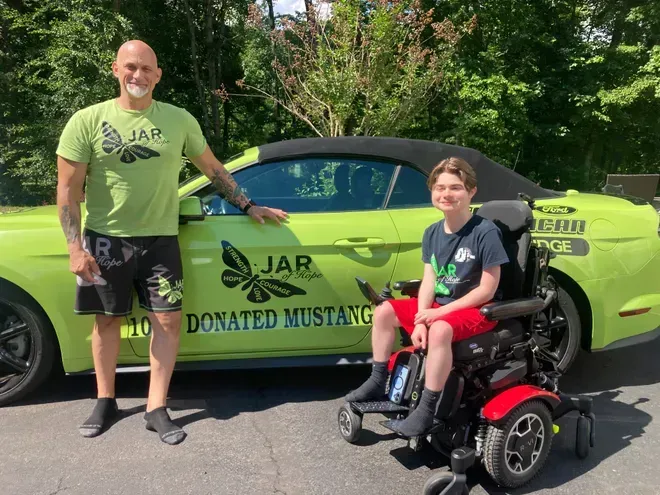
MANALAPAN -- Jamesy Raffone turned 17 in March, and like most kids his age, he’s eager to get his driver’s license.
“It’ll be cool, the freedom of it,” he said.
His journey to that freedom, though, contains a lot more twists and turns than the typical teen’s. Jamesy has Duchenne muscular dystrophy, a genetic condition that results in a progressive loss of strength and eventually leads to paralysis and fatal heart and lung problems.
When he was diagnosed, at age 4, a geneticist told Jamesy’s parents driving would be impossible. That is no longer the case. At Howell High School, as a junior taking driver’s education, Jamesy passed his written permit test earlier this year.
“It wasn’t hard,” he said.
Now comes the harder part: Driving lessons with an accessible vehicle that is outfitted with custom-fit hand controls so Jamesy, who gets around in a motorized wheelchair, does not need his legs to brake or accelerate. It’ll be costly, time-consuming and rigorous — the kind of challenge the Raffones have taken on time and again over the years through their nonprofit JAR of Hope, which helps Duchenne families.
“By getting his license after being told he’ll never do it, he’s defying the odds and leading the way for other kids like him,” dad Jim Raffone said. “We want to be able to show them, those kids, that’s it’s possible — you can do this.”
Beating expectations
At the time of Jamesy’s diagnosis, the median life expectancy of a Duchenne patient was 23. Now it’s close to 30. Even by the improved benchmarks, Jamesy is doing well. He receives a stem-cell infusion every 45 days.
“He’s head and shoulders above where he could be or should be for the milestones of a child with Duchenne,” Jim Raffone said. “He can sit upright — no scoliosis. His heart is good. He still has movement in his upper girdle (his arms and torso), which is amazing at this stage.”
Keeping that movement is the key to being able to operate the joysticks that drive a specially outfitted car. In order to figure out which hand controls work best for Jamesy and instruct him on their use, the Raffones are working with Brant’s Driving School in Western Pennsylvania, which specializes in adaptive training.
After a test run with a Brant vehicle at their Manalapan home, Jamesy and mom Karen Raffone are heading out there in July for a three-week course.
Then they’ll have to get those controls installed in their own van. The whole enterprise could cost upwards of $40,000.
“If we didn’t have the support of JAR of Hope, what would we do?” Jim Raffone said. “I don’t think he’d be able to drive.”
Jim built the charity through years of audacious initiatives, including assembling the world’s longest Lego chain, hiking to Mount Everest base camp, ringing the closing bell of the New York Stock Exchange, and running a series of ultramarathons. In early May, despite three herniated discs in his neck suffered in a car accident, Jim completed the Mingus Traverse — an 82-mile race through Arizona desert and mountains. He crossed the line 117th out of 118 finishers in a time of 43 hours and 15 minutes.
“It was so grueling,” he said.
Then he underwent surgery.
'My son has taught me a lot'
In Raffone’s garage is a motorized wheelchair JAR of Hope purchased for a family in Texas. Jim plans on delivering it personally in late June.
“Sometime after Father’s Day,” he said.
Father’s Day carries deep meaning for this family. When Jim first ventured into Duchenne advocacy, he said, moms were doing most of the heavy lifting. By his count, there are now eight dads who branched off of JAR of Hope to start their own initiatives.
“They’re all raising a tremendous amount of money for the community,” he said. “It’s a second degree from JAR of Hope, and it’s very flattering. To give them that inspiration, that feeling that they can go out there and do this too, it’s pretty awesome.”
Jim’s inspiration comes from within his own household.
“My son has taught me a lot about resiliency,” he said.
Driving was supposed to be out of reach for Jamesy. Who knows what barrier he’ll bust through next.
“I always tell people, ‘Never give up,’” his dad said. “You have to keep pushing. The cure, or something to slow down the disease, could come at any time.”
For more information on JAR of Hope, visit www.jarofhope.org.
Jerry Carino is community columnist for the Asbury Park Press, focusing on the Jersey Shore’s interesting people, inspiring stories and pressing issues. Contact him at
jcarino@gannettnj.com.