Sarepta's 27% Sell-Off Is 'Overblown,' 'Overdone' And 'Overly Bearish.' Here's Why It Happened.

From Investors.com


Sarepta stock crashed Tuesday after a patient who received its approved gene therapy, Elevidys, died due to acute liver failure.

Elevidys treats Duchenne muscular dystrophy, a devastating disorder that causes progressive muscle deterioration. According to Sarepta Therapeutics (SRPT), the patient developed acute liver failure following treatment with Elevidys. He also had a recent cytomegalovirus infection, or CMV, which could have been a contributing factor. CMV can injure the liver.


This is the "event people had feared," said RBC Capital Markets analyst Brian Abrahams. But it "shouldn't spell the end for Elevidys."


"The news is certainly not good, but given the known liver toxicities associated with Elevidys and all gene therapies, the fragile nature of the patients with this deadly illness being treated and the growing use of the agent, it is perhaps not altogether surprising that a fatal (adverse event) could potentially be observed occasionally," he said in a note.


Still on today's stock market, Sarepta stock toppled 27.4%, closing at 73.54.


'Very Unique' Case

Sarepta didn't provide any identifying characteristics about the patient other than to describe him as a "young man."


William Blair analyst Sami Corwin said the patient was a 16-year-old boy. Analysts noted older and non-ambulatory patients would typically weigh more and require a larger dose of Elevidys. Further, older patients have a higher morbidity, Leerink Partners analyst Joseph Schwartz said in a report.


This is the first fatality among Elevidys recipients. Sarepta says it has treated north of 800 patients weighing up to 300 pounds with Elevidys in testing and following approval. Sarepta believes this case is "very unique," Schwartz said.


"Although we acknowledge that such severe side effects associated with mortality can certainly be alarming and cause the community to question the risk/benefit of treating older patients, we believe that the very low overall incidence which we estimate at less than 0.125% based on aggregate exposure to date is encouraging," he said.


He reiterated his outperform rating on Sarepta stock.


Well-Known Side Effect

Liver toxicity is associated with AAV-based gene therapies. These drugs use non-harmful viruses known as adeno-associated viruses, or AAV, to deliver therapeutic genes to the cells. In this case, the drug tells the body how to make a shortened version of the dystrophin protein that's missing in Duchenne patients. Dystrophin helps keep muscles intact and functional.


William Blair's Corwin noted two patients died following treatment with Novartis' (NVS) Zolgensma, a treatment for spinal muscular atrophy.


"Overall, we see this event as unlikely to affect patient/physician interest in Elevidys in the near term or Sarepta's full year 2025 product revenue guidance of $2.9 billion to $3.1 billion," she said in a report.


Analysts called the sell-off "overblown," "overdone" and "overly bearish."


"Thus we think this is an overreaction and presents a buying opportunity ahead of a continued strong Elevidys launch," Leerink's Schwartz said.


Meanwhile, shares of Regenxbio (RGNX), which is working on Duchenne gene therapies, rose 11.6% to 7.81. Solid Bio (SLDB), another gene therapy competitor, saw shares shrink 4.9%, trading down at 5.10.

New Button
June 26, 2026
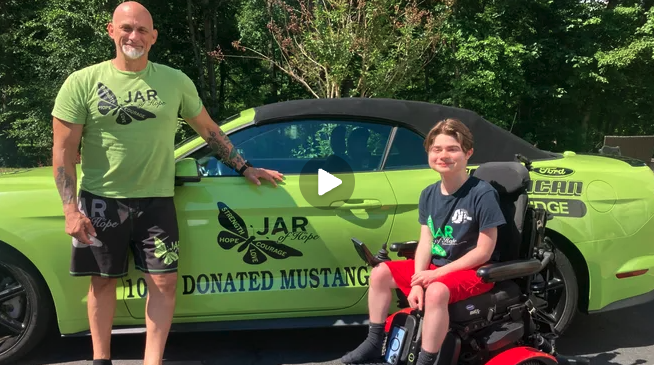
MANALAPAN -- Jamesy Raffone turned 17 in March, and like most kids his age, he’s eager to get his driver’s license. “It’ll be cool, the freedom of it,” he said. His journey to that freedom, though, contains a lot more twists and turns than the typical teen’s. Jamesy has Duchenne muscular dystrophy, a genetic condition that results in a progressive loss of strength and eventually leads to paralysis and fatal heart and lung problems. When he was diagnosed, at age 4, a geneticist told Jamesy’s parents driving would be impossible. That is no longer the case. At Howell High School, as a junior taking driver’s education, Jamesy passed his written permit test earlier this year. “It wasn’t hard,” he said. Now comes the harder part: Driving lessons with an accessible vehicle that is outfitted with custom-fit hand controls so Jamesy, who gets around in a motorized wheelchair, does not need his legs to brake or accelerate. It’ll be costly, time-consuming and rigorous — the kind of challenge the Raffones have taken on time and again over the years through their nonprofit JAR of Hope, which helps Duchenne families. “By getting his license after being told he’ll never do it, he’s defying the odds and leading the way for other kids like him,” dad Jim Raffone said. “We want to be able to show them, those kids, that’s it’s possible — you can do this.” Beating expectations At the time of Jamesy’s diagnosis, the median life expectancy of a Duchenne patient was 23. Now it’s close to 30. Even by the improved benchmarks, Jamesy is doing well. He receives a stem-cell infusion every 45 days. “He’s head and shoulders above where he could be or should be for the milestones of a child with Duchenne,” Jim Raffone said. “He can sit upright — no scoliosis. His heart is good. He still has movement in his upper girdle (his arms and torso), which is amazing at this stage.” Keeping that movement is the key to being able to operate the joysticks that drive a specially outfitted car. In order to figure out which hand controls work best for Jamesy and instruct him on their use, the Raffones are working with Brant’s Driving School in Western Pennsylvania, which specializes in adaptive training. After a test run with a Brant vehicle at their Manalapan home, Jamesy and mom Karen Raffone are heading out there in July for a three-week course. Then they’ll have to get those controls installed in their own van. The whole enterprise could cost upwards of $40,000. “If we didn’t have the support of JAR of Hope, what would we do?” Jim Raffone said. “I don’t think he’d be able to drive.” Jim built the charity through years of audacious initiatives, including assembling the world’s longest Lego chain , hiking to Mount Everest base camp , ringing the closing bell of the New York Stock Exchange , and running a series of ultramarathons. In early May, despite three herniated discs in his neck suffered in a car accident, Jim completed the Mingus Traverse — an 82-mile race through Arizona desert and mountains. He crossed the line 117th out of 118 finishers in a time of 43 hours and 15 minutes. “It was so grueling,” he said. Then he underwent surgery. 'My son has taught me a lot' In Raffone’s garage is a motorized wheelchair JAR of Hope purchased for a family in Texas. Jim plans on delivering it personally in late June. “Sometime after Father’s Day,” he said. Father’s Day carries deep meaning for this family. When Jim first ventured into Duchenne advocacy, he said, moms were doing most of the heavy lifting. By his count, there are now eight dads who branched off of JAR of Hope to start their own initiatives. “They’re all raising a tremendous amount of money for the community,” he said. “It’s a second degree from JAR of Hope, and it’s very flattering. To give them that inspiration, that feeling that they can go out there and do this too, it’s pretty awesome.” Jim’s inspiration comes from within his own household. “My son has taught me a lot about resiliency,” he said. Driving was supposed to be out of reach for Jamesy. Who knows what barrier he’ll bust through next. “I always tell people, ‘Never give up,’” his dad said. “You have to keep pushing. The cure, or something to slow down the disease, could come at any time.” For more information on JAR of Hope, visit www.jarofhope.org . Jerry Carino is community columnist for the Asbury Park Press, focusing on the Jersey Shore’s interesting people, inspiring stories and pressing issues. Contact him at jcarino@gannettnj.com .
June 26, 2026
Duchenne muscular dystrophy (DMD) is caused by mutations in the dystrophin gene. Not one mutation. Hundreds of them. These different mutations can disable the gene, each occurring in a different part of the DNA sequence. The mutation a patient carries determines which treatments they are eligible for. Exon-skipping drugs, the most widely prescribed category of DMD treatment, work by prompting the body to produce a partial dystrophin by reading around the damaged section of the gene. Each drug targets a specific exon, and each exon covers only a specific subset of patients. Sarepta's approved exon-skipping portfolio includes three distinct drugs, each addressing a different exon group and each serving a different slice of the DMD population. But a patient whose mutation falls outside those covered groups has no approved exon-skipping option. Full-length gene replacement delivers a complete, functional copy of the dystrophin gene rather than prompting the body to produce a partial one. That doesn’t depend on specific mutations. Instead, it’s being developed as a mutation-agnostic gene replacement approach. The platform has not yet been tested in humans, and all current data comes from preclinical animal models. Myosana Therapeutics’ design represents a new category of approach: mutation-agnostic, beyond any requirement to match a specific mutation to a specific drug. The company believes this design may have broader applicability across mutation types, though that has not been evaluated in human studies. Invest in Myosana Therapeutics on Wefunder This offering is made under Regulation CF. Investments are speculative, illiquid, and involve a high degree of risk. You should not invest unless you can afford to lose your entire investment. Please review all offering materials on Wefunder before investing in Myosana Therapeutics.
November 18, 2025
The body content of your post goes here. To edit this text, click on it and delete this default text and start typing your own or paste your own from a different source.
More Posts